Between 9th and 16th April 2012 Philip Round made a trip to Ko Man Nai. in the Gulf of Thailand, in hope of ringing scarce migrants. He was successful in finding Thailand's second Fairy Pitta as well as at least 13 Japanese Paradise Flycatchers.
The news of this prompted quite a number of people to make the trip to Ko Man Nai in search of these birds and it appears that a few more Fairy Pittas were discovered. However, this influx of birders has caused a problem on the island and Phil Round requests that birdwatchers do not visit the island unless they have first obtained the relevant permission. Read Phil's request yourself - Please do not visit Ko Man Nai without first obtaining official permission.
This discovery suggests that both Fairy Pitta and Japanese Paradise Flycatcher are more frequent visitors to Thailand than previously thought and these, plus other rare visitors, may be found on similar islands in the Gulf during migratory periods. Migrants such as these that follow a more Eastern flyway than the commoner passage migrants in Thailand usually turn up in the first half of April.
Good luck in finding your own treasure trove of migrants during passage migration times.
Tuesday, June 12, 2012

Tuesday, April 10, 2012
Thailand Birding: Sri Nakorn Kuan Khan Park
On 3rd April 2012 I found myself with the rare opportunity to get out for a morning close to home. Having had great success in finding migrant species in April 2011 at Sri Nakorn Kuan Khan park, Bangkok, I decided to see if I could get lucky again.
Arriving at about 7am seemed a bit early as my first walk around revealed little other than a Forest Wagtail, a couple of Spangled (Hair-crested) Drongos and the odd Black-naped Oriole. However, a few nice resident birds included Pink-necked Green Pigeon and Stork-billed Kingfisher, both of which are commoner here than anywhere else I know in Thailand, as well as a male Laced Woodpecker.
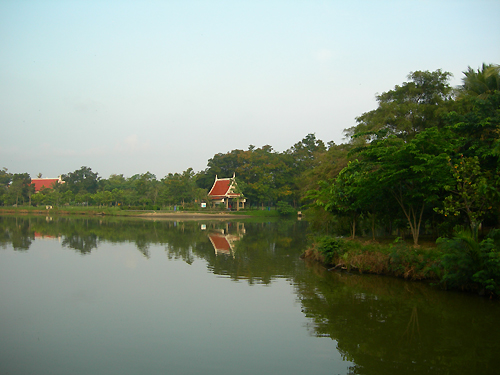

Arriving at about 7am seemed a bit early as my first walk around revealed little other than a Forest Wagtail, a couple of Spangled (Hair-crested) Drongos and the odd Black-naped Oriole. However, a few nice resident birds included Pink-necked Green Pigeon and Stork-billed Kingfisher, both of which are commoner here than anywhere else I know in Thailand, as well as a male Laced Woodpecker.
Sri Nakorn Kuan Khan Park
On previous visits to Bangkok's parks, looking for migrants, I have noticed that most of the best observations seem to occur between 9am and midday, so I made another lap of the park.
Over the next few hours I came across several flocks of small migrant species which included 1 Drongo Cuckoo, 3 Crow-billed Drongos, 1 Lesser Racket-tailed Drongo (quite a surprise to me), 2 Black-winged Cuckooshrikes, 1 Eyebrowed Thrush (1 or 2 others heard passing overhead), 10 Black-naped Orioles, 3 Ashy Minivets and 1 Swinhoe's Minivet.
Also scattered around the unkempt parts of the park (towards the back) I came across a few flycatchers and Phylloscopus warblers which included 5 Radde's Warblers, 2 Pale-legged Leaf Warblers, 1 Arctic Warbler, 2 Yellow-browed Warblers, 3 dauurica Asian Brown Flycatchers, 1 siamensis Asian Brown Flycatcher plus 3 male & 1 female Yellow-rumped Flycatchers.
At around mid morning (10am ish) I spent 20 minutes at the top of the birdwatching observation tower, where I have spotted many interesting birds from before. As well as some common resident species I saw a few more passing migrants; a total of 13 Black Bazas and 2 Japanese Sparrowhawks as well as 2 Dollarbirds.
By midday I was very tired from walking around in the heat and humidity for 5 hours so decided to retreat to the air-conditioning of the car. On the way back I had time to add a Hodgson's Hawk Cuckoo to the list of migrants!
It seems that Sri Nakorn Kuan Khan park is an excellent place to find good numbers of migrating birds in April. I have never managed to get to the park during Autumn migration but I hope to put that right later this year.
Thursday, December 1, 2011
Thailand Birding: Raptors At Petchaburi
The rice fields around the town of Petchaburi always play host to a good number and variety of raptors in the dry season. The areas known as Nong Pla Lai and Tung Bang Jak are just a collection of rice fields and other mixed agriculture just a few kilometres north of Petchaburi and can be reached by turning left of the highway just as the temples on the hill in Petchaburi becomes visible - a distance of about 2-3 kilometres north of the town.
In the last few weeks I have seen large numbers of Black Kites (100+) as well as 4 or 5 Greater Spotted Eagles. At least 2 Eastern Imperial Eagles are also currently in the area and at least 1 juvenile Steppe Eagle has been seen by myself and other observers and I have seen at least 2 different Booted Eagles. Another interesting raptor that is present in the area is Pied Harrier, although I have only seen juveniles recently, but the fantastic adult males do turn up sometimes.

Black Kites can frequently be seen sitting around in trees and other perches like the birds in the photo, almost exclusively they are of the lineatus race. Other raptors which are commonly seen in this area are Eastern Marsh Harrier, Peregrine, Brahminy Kite, Osprey and Black-shouldered Kite.
Rarer raptors do also show up in this area from time to time with a Slender-billed Vulture recently being photographed and last winter a Cinereous Vulture and 2 Himalayan Griffons were seen. A juvenile Amur Falcon was also photographed nearby in recent weeks.
For those birders who are raptor enthusiasts, the rice fields around Petchaburi are a must-visit location between mid November and mid March.
In the last few weeks I have seen large numbers of Black Kites (100+) as well as 4 or 5 Greater Spotted Eagles. At least 2 Eastern Imperial Eagles are also currently in the area and at least 1 juvenile Steppe Eagle has been seen by myself and other observers and I have seen at least 2 different Booted Eagles. Another interesting raptor that is present in the area is Pied Harrier, although I have only seen juveniles recently, but the fantastic adult males do turn up sometimes.

Black Kites
By Alex Vargas
Black Kites can frequently be seen sitting around in trees and other perches like the birds in the photo, almost exclusively they are of the lineatus race. Other raptors which are commonly seen in this area are Eastern Marsh Harrier, Peregrine, Brahminy Kite, Osprey and Black-shouldered Kite.
Rarer raptors do also show up in this area from time to time with a Slender-billed Vulture recently being photographed and last winter a Cinereous Vulture and 2 Himalayan Griffons were seen. A juvenile Amur Falcon was also photographed nearby in recent weeks.
For those birders who are raptor enthusiasts, the rice fields around Petchaburi are a must-visit location between mid November and mid March.
Thursday, November 10, 2011
Thailand Birding: Migrants Still Returning
Migration continues throughout November and even into December in Thailand with different species having different migratory routes and times.
On the 9th November I revisited Pak Thale and Laem Pak Bia again and there were a few notable differences in numbers and presence of a few migratory species.
The those who are eager of the very latest Spoon-billed Sandpiper news, I saw 2 of this critically endangered species on salt pans at Pak Thale on 9th.
However, it was at nearby Wat Komnaram that I noticed a few interesting changes. Since my visit on 2nd November the number of Grey-headed Lapwings had dropped to 5 birds and the Black-headed Ibis numbers had decreased to 7. However, notable arrivals included more than 100 Red-throated Pipits that seemed to be passing through in the early morning and the arrival of 11 Garganey. Another interesting development were several oriental Skylarks singing when they had not been a week ago.
At nearby Laem Pak Bia I came across a total of 5 Richard's Pipits loafing around on dirt roads. This was a decline from at least 12 Richard's Pipits in the same location on 24th October. Most of these Richard's Pipits were significantly larger than the resident Paddyfield Pipits but the calls of all of them confirmed their identification.
On the 9th November I revisited Pak Thale and Laem Pak Bia again and there were a few notable differences in numbers and presence of a few migratory species.
The those who are eager of the very latest Spoon-billed Sandpiper news, I saw 2 of this critically endangered species on salt pans at Pak Thale on 9th.
However, it was at nearby Wat Komnaram that I noticed a few interesting changes. Since my visit on 2nd November the number of Grey-headed Lapwings had dropped to 5 birds and the Black-headed Ibis numbers had decreased to 7. However, notable arrivals included more than 100 Red-throated Pipits that seemed to be passing through in the early morning and the arrival of 11 Garganey. Another interesting development were several oriental Skylarks singing when they had not been a week ago.
At nearby Laem Pak Bia I came across a total of 5 Richard's Pipits loafing around on dirt roads. This was a decline from at least 12 Richard's Pipits in the same location on 24th October. Most of these Richard's Pipits were significantly larger than the resident Paddyfield Pipits but the calls of all of them confirmed their identification.
Friday, November 4, 2011
Thailand Birding: Black-headed Ibis & Other Large Waterbirds
Black-headed Ibis is a very uncommon bird in Thailand, but, like many other large waterbirds, they are increasing in number.
In the past many large waterbirds, such as storks, ibises, pelicans, herons etc. were very common birds but years of agricultural intensification and persecution wiped many of these species out or made them very rare in Thailand. Fortunately, as persecution is not the problem it once was and many of these birds are making a comeback.
Black-headed Ibis seem to frequent the Petchaburi region virtually all year round. Most often they can be found in the region of Wat Khao Takrao, but more and more frequently I see them on a large muddy field outside Wat Komnaram, near Pak Thale. Throughought the dry season 2010-2011 one bird was present for a long time and on 25th October 2011 I found 6 birds feeding at this location. A week later, on 3rd November, I found 18 Black-headed Ibises feeding close to the road at the same location; here is a video clip of some of them.
On both 25th October and 3rd November 1 Milky Stork and several Painted Storks were also to be seen at this site, further highlighting the recovery of large waterbirds. In fact such is the recovery that Painted Storks are now fairly commonplace in the Laem Pak Bia/Pak Thale area, Asian Openbills are common throught much of the country and Spot-billed Pelican occurs in every increasing numbers in the wet season.
Other large waterbirds that have increased in number over the last 10 years include Purple Heron, Oriental darter, Glossy Ibis and Indian Cormorant. Watch out too for Sarus Crane, a small number of which have been reintroduced in Buriram province.
Good news for large waterbirds!
In the past many large waterbirds, such as storks, ibises, pelicans, herons etc. were very common birds but years of agricultural intensification and persecution wiped many of these species out or made them very rare in Thailand. Fortunately, as persecution is not the problem it once was and many of these birds are making a comeback.
Black-headed Ibis seem to frequent the Petchaburi region virtually all year round. Most often they can be found in the region of Wat Khao Takrao, but more and more frequently I see them on a large muddy field outside Wat Komnaram, near Pak Thale. Throughought the dry season 2010-2011 one bird was present for a long time and on 25th October 2011 I found 6 birds feeding at this location. A week later, on 3rd November, I found 18 Black-headed Ibises feeding close to the road at the same location; here is a video clip of some of them.
On both 25th October and 3rd November 1 Milky Stork and several Painted Storks were also to be seen at this site, further highlighting the recovery of large waterbirds. In fact such is the recovery that Painted Storks are now fairly commonplace in the Laem Pak Bia/Pak Thale area, Asian Openbills are common throught much of the country and Spot-billed Pelican occurs in every increasing numbers in the wet season.
Other large waterbirds that have increased in number over the last 10 years include Purple Heron, Oriental darter, Glossy Ibis and Indian Cormorant. Watch out too for Sarus Crane, a small number of which have been reintroduced in Buriram province.
Good news for large waterbirds!
Thursday, November 3, 2011
Thailand Birding: Spoon-billed Sandpiper Returns!
For all those birders visiting Thailand over the next few months who were getting nervous about whether this critically endangered species would make it back to Thailand this winter, the good news is yes it did!
Phil Round informed me that at least 2 were seen at Khok Kham from 22nd October and 2 or 3 at Pak Thale from the end of October. I can confirm this as I saw 1 Spoon-billed Sandpiper myself at Pak Thale this morning.

Lots of other shorebirds were also present and giving good, close-up views. 1 adult Little Stint was amongst numerous Red-necked Stints and 5 Dunlin were with a flock of Broad-billed Sandpipers. A large flock of 1000+ Great Knot, 200+ Eurasian Curlew and large numbers of all the common shorebirds too.
More good news for rarity hunters were at least 9 Nordmann's Greenshank at Laem Pak Bia.
I revisited Wat Komnaram too and the Black-headed Ibis from last week had increased to 18 birds, plus the Milky Stork was feeding close to the road.
Phil Round informed me that at least 2 were seen at Khok Kham from 22nd October and 2 or 3 at Pak Thale from the end of October. I can confirm this as I saw 1 Spoon-billed Sandpiper myself at Pak Thale this morning.

Spoon-billed Sandpiper & Red-necked Stint
Photo by Marco Witte
Lots of other shorebirds were also present and giving good, close-up views. 1 adult Little Stint was amongst numerous Red-necked Stints and 5 Dunlin were with a flock of Broad-billed Sandpipers. A large flock of 1000+ Great Knot, 200+ Eurasian Curlew and large numbers of all the common shorebirds too.
More good news for rarity hunters were at least 9 Nordmann's Greenshank at Laem Pak Bia.
I revisited Wat Komnaram too and the Black-headed Ibis from last week had increased to 18 birds, plus the Milky Stork was feeding close to the road.
Tuesday, November 1, 2011
Thailand Birding: Shorebirds at Pak Thale
One of the most anticipated arrivals each year is that of Spoon-billed Sandpiper. Birdwatchers from all over the world come to Thailand to watch this critically endangered shorebird at Pak Thale and Khok Kham.
A few days ago on 25th October, 2012, I did a little birding at Pak Thale in the company of Jules Tolboom from The Netherlands. We spent around 1.5 hours in the late afternoon at Pak Thale watching large numbers of shorebirds.

We had a long hard look at all the shorebirds that could be seen from the dirt road at the Spoon-billed Sandpiper site at Pak Thale but despite looking hard none appeared to be present. In fact this is pretty much as expected as it was probably about 1 week too early for the bird.
Despite the lack of Spoon-billed Sandpiper there were very impressive numbers of Great Knot (1500+) and Eurasian Curlew (250+) as well as good numbers of Red-necked Stint, Lesser Sand Plover, Greater Sand Plover, Kentish Plover, Curlew Sandpiper, Broad-billed Sandpiper, Eastern Black-tailed Godwit and Marsh Sandpiper.
The most uncommon bird was one Eastern Curlew amongst the flock of Eurasian Curlews which I picked out due to its warm brown buffy appearance. Identification was ensured when it began to preen and showed me its dark underwing (pale/white on Eurasian Curlew). It ought to be noted that length of bill is not an identification point here where the female Eurasian Curlews have bills that are as long (if not longer) than the Eastern Curlews.
Other species present were Red Knot, Dunlin, Whimbrel, Spotted Redshank and Common Greenshank.
Elsewhere at nearby Wat Komnaram a Milky Stork was seen alongside two Painted Storks and 6 Black Ibis and 36 Grey-headed Lapwings were feeding.
Spoon-billed Sandpiper should be back next week!
A few days ago on 25th October, 2012, I did a little birding at Pak Thale in the company of Jules Tolboom from The Netherlands. We spent around 1.5 hours in the late afternoon at Pak Thale watching large numbers of shorebirds.

Curlew Sandpipers with Broad-billed Sandpiper
Photo by Alex Vargas
We had a long hard look at all the shorebirds that could be seen from the dirt road at the Spoon-billed Sandpiper site at Pak Thale but despite looking hard none appeared to be present. In fact this is pretty much as expected as it was probably about 1 week too early for the bird.
Despite the lack of Spoon-billed Sandpiper there were very impressive numbers of Great Knot (1500+) and Eurasian Curlew (250+) as well as good numbers of Red-necked Stint, Lesser Sand Plover, Greater Sand Plover, Kentish Plover, Curlew Sandpiper, Broad-billed Sandpiper, Eastern Black-tailed Godwit and Marsh Sandpiper.
The most uncommon bird was one Eastern Curlew amongst the flock of Eurasian Curlews which I picked out due to its warm brown buffy appearance. Identification was ensured when it began to preen and showed me its dark underwing (pale/white on Eurasian Curlew). It ought to be noted that length of bill is not an identification point here where the female Eurasian Curlews have bills that are as long (if not longer) than the Eastern Curlews.
Other species present were Red Knot, Dunlin, Whimbrel, Spotted Redshank and Common Greenshank.
Elsewhere at nearby Wat Komnaram a Milky Stork was seen alongside two Painted Storks and 6 Black Ibis and 36 Grey-headed Lapwings were feeding.
Spoon-billed Sandpiper should be back next week!
Subscribe to:
Posts (Atom)